Elemental impurities
Managing elemental impurities (EIs) is more than a regulatory requirement, it’s a critical safeguard for patient safety and product integrity.
Even at trace levels, inorganic contaminants can compromise compliance, delay approvals and threaten your time-to-market. According to regulatory standards ICH Q3D, USP <232>/<233>and Ph. Eur. 2.4.20, we help you define a robust and compliant control strategy.
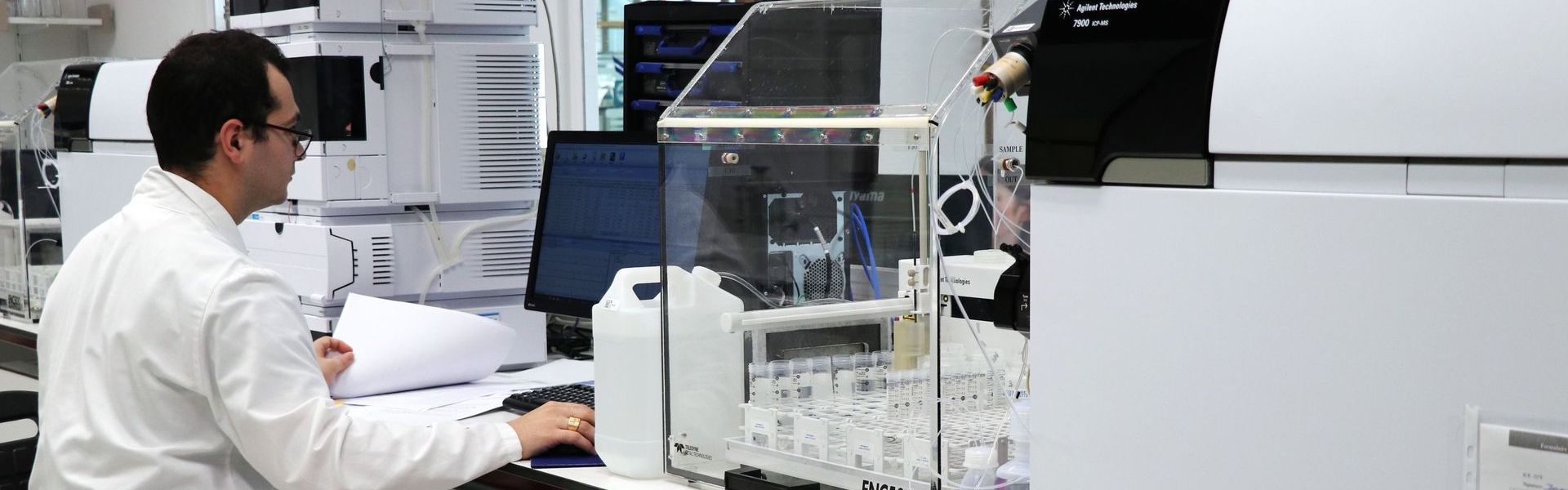
At Quality Assistance, our integrated approach combines scientific expertise, regulatory insight and advanced ICP-MS technology to help you anticipate, assess and control elemental impurity risks throughout your entire development lifecycle. From risk assessment to validated analytical methods, we ensure your products meet global standards with efficiency and reliability.
Regulatory framework

We ensure full compliance with international guidelines:
- ICH Q3D (R2): Elemental Impurities Guideline
- USP <232>/<233>: Elemental Impurities: procedures and limits
- Ph. Eur. 2.4.20: Determination of Elemental Impurities
These guidelines apply to APIs, excipients and finished drug products, including biotech-derived substances.
Risks assessment strategies

We support both approaches defined by ICH Q3D:
- Assessment based on final drug product: ideal when limited information on drug components, manufacturing equipment, formulation etc. is available
- Assessment based on product components: preferred for new drug products where early assessment of EIs in formulation components may prevent downstream non-compliance
We help you define the optimal strategy and advise when systematic analytical testing is required to assess product safety.
Analytical methods

We provide a complete GMP-certified service tailored to both routine and development activities. We have developed and validated generic ICP-MS methods applicable to drug substances, drug products and excipients:
- Method 1: Determination of 23 elements (all ICH Q3D except osmium) in a single run
- Method 2: Osmium determination using isotopic dilution
- Method 3: Determination of 23 elements in TiO2, SiO2 or talc-based matrices with HF digestion
Methods 1 and 2 are validated for specificity, linearity, accuracy, precision and intermediate precision.
Laboratory capacities

- 5 ICP-MS for trace detection even at low levels
- 2 Microwave digestion systems for complete and efficient sample preparation
- GMP-certified analytical environment
- Dedicated analytical team
Scientific and technical support

Whether you need full control, gap closure or regulatory justification, our experts guide you through every decision
- Definition of a control strategy to justify the need (or absence) of systematic analytical testing
- Execution of all required ICP-MS determinations and method validations
Your benefit of working with us
- Integrated risk assessment and analytical services for complete control
- Validated generic methods applicable to a wide range of samples
- Reliable compliance with ICH Q3D, USP, and Ph. Eur. standards
- Single-site model ensuring efficiency, consistency, and rapid turnaround
- Strategic partnership strengthening confident decision making and timelines
Let's work together

Let’s secure your product development together, from risk assessment to validated testing. Partner with us for proven elemental impurity control.